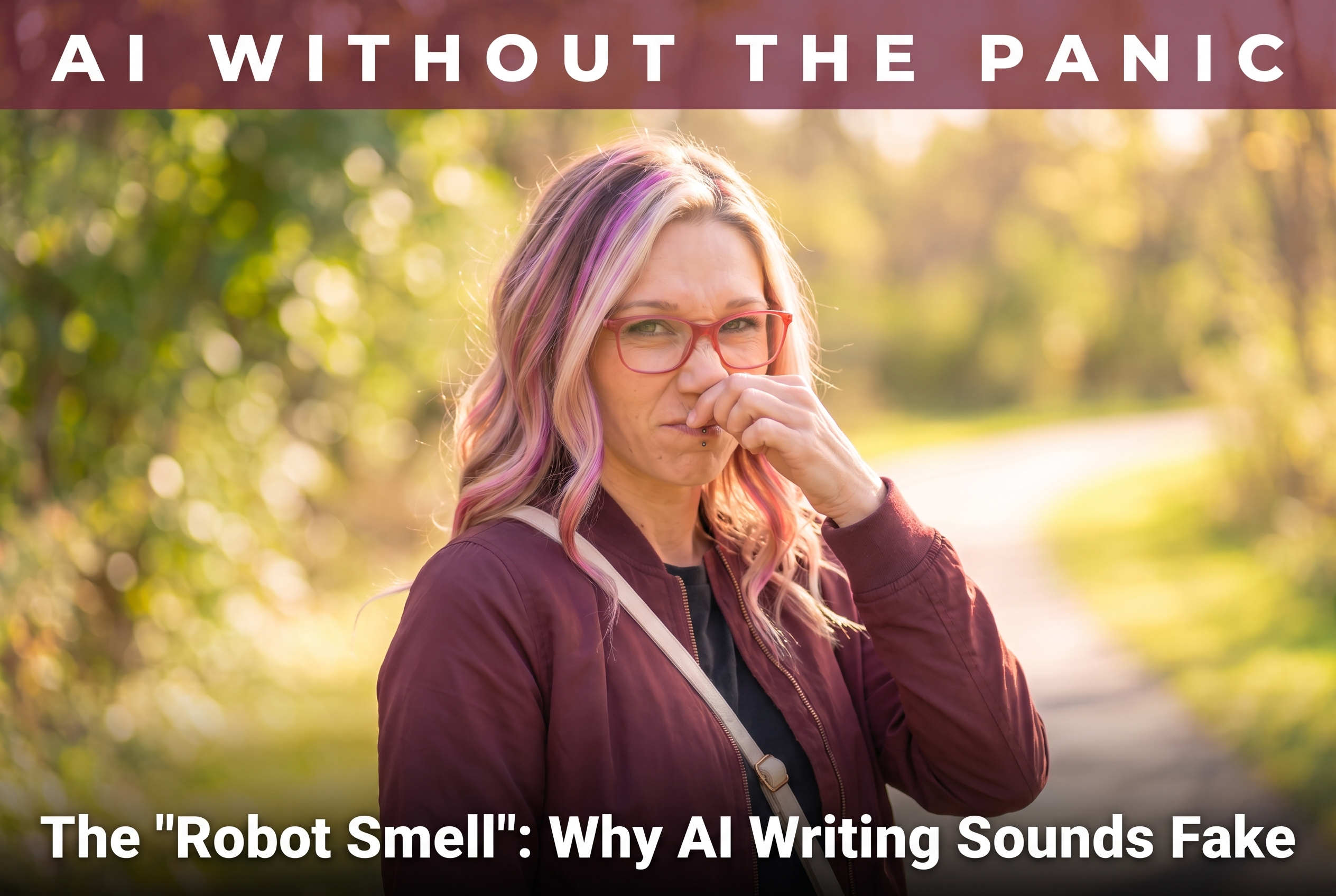
You can usually tell within a sentence or two. Something about the phrasing feels slightly off, a little too smooth, a little too eager to sound impressive. Nobody actually talks like that, and somehow everyone reading it knows it, even if they can’t quite say why.
That’s the robot smell: the specific set of habits AI writing falls into by default, which readers now recognize on sight even without knowing the exact tells.
Where the Smell Actually Comes From
AI language models are trained to sound broadly competent and inoffensive across every possible topic at once. That training produces writing that’s technically correct and reads like it was written by someone trying very hard not to say anything wrong, rather than someone with an actual point of view. The result is smooth, hedge-y, and strangely impersonal — polished in a way that reads as synthetic rather than professional.
Once you know what to look for, the pattern becomes obvious everywhere.
The Tells, One by One
Certain words show up constantly. Leverage. Delve. Seamless. Robust. Elevate. These aren’t wrong exactly, they’re just overused to the point that they’ve become a signal on their own — the verbal equivalent of stock photography.
Everything comes in threes. “Fast, reliable, and scalable.” “Clear, concise, and actionable.” AI defaults to grouping ideas in tidy sets of three, and once you notice it, you’ll see it everywhere in generated text — it’s rhythmically pleasant but structurally predictable, which is exactly what makes it recognizable.
Negative parallelism shows up everywhere. “It’s not just about the tools, it’s about the mindset.” One or two of these can work. A paragraph full of them starts to read like a template rather than a thought.
Filler phrases pad out sentences that don’t need them. “It’s important to note that…” “At the end of the day…” These phrases don’t add meaning, they just add length, and readers can feel the difference between a sentence that’s saying something and one that’s stalling.
What Actually Fixes It
Say the specific thing, not the safe thing. Generic advice tries to apply to everyone at once, which is exactly why it ends up applying to no one in particular. A real opinion, even a debatable one, reads as more human than a balanced summary of every possible view.
Cut the three-item lists down to what’s actually there. If there are two good points, say two. If there’s one strong point, say one. Padding a list to hit a rhythm is one of the fastest ways to sound generated rather than written.
Read it out loud. Robot smell is much easier to hear than to see. If a sentence would sound strange coming out of your mouth in conversation, it needs to be rewritten, no matter how polished it looks on the page.
Keep the rough edges that are actually true. A specific detail, a slightly unusual word choice, an opinion stated plainly instead of softened — these are the things that make writing sound like it came from an actual person who was actually there, rather than from a system trying to sound like one.
Where This Leaves You
None of this means avoiding AI as a writing tool. It means treating the first draft as a draft, not a finished product. The smell isn’t really about vocabulary or sentence structure on their own — it’s about writing that’s optimized to avoid saying anything wrong instead of writing that’s trying to actually say something. Fix that, and most of the other tells disappear along with it.
Leave a Reply