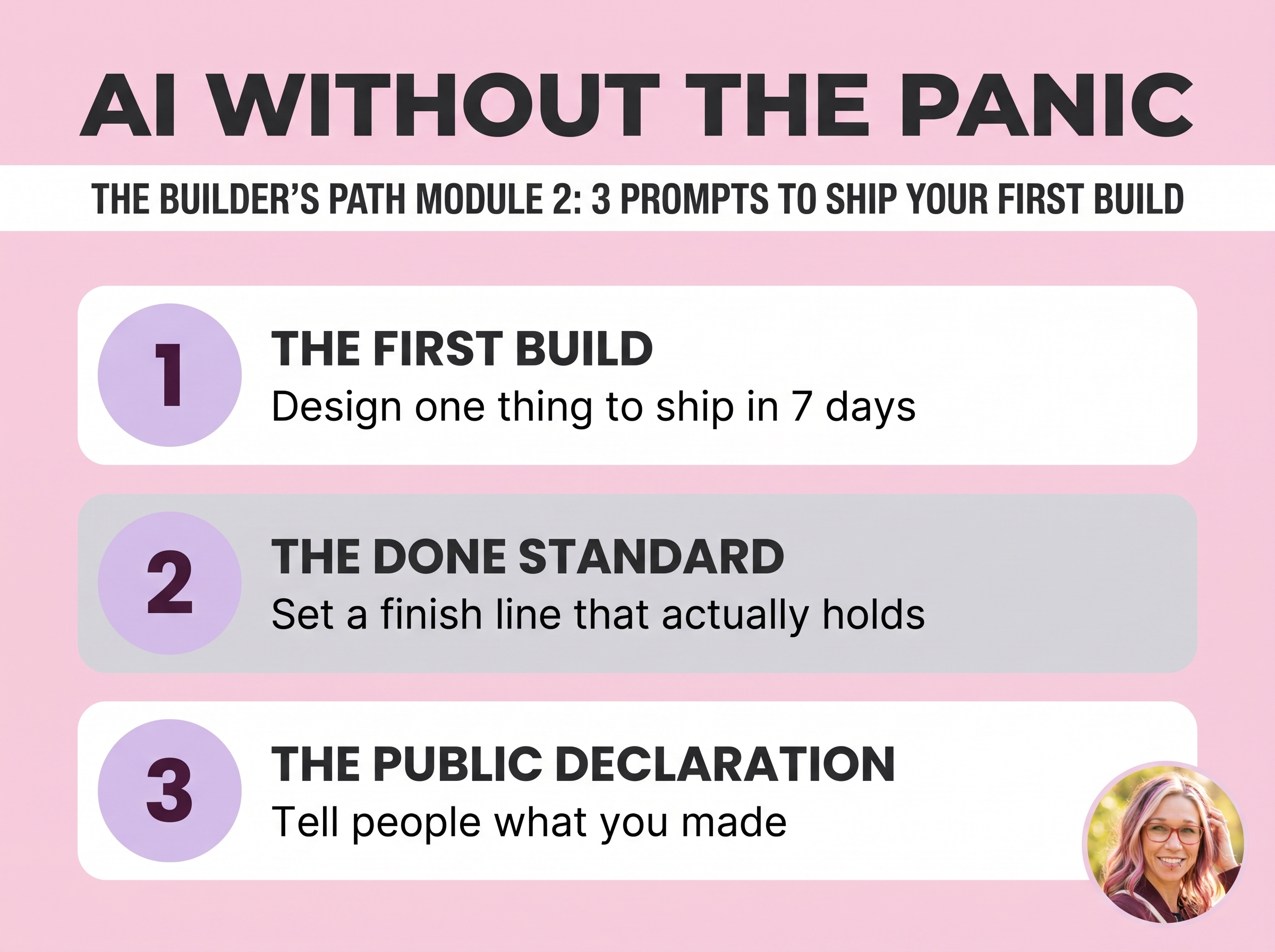
Module 1 got you honest — the real ratio, the excuse you’ve been hiding behind, the proof that you already build more than you give yourself credit for. None of that means anything until it turns into a real, finished thing that didn’t exist before, that someone else knows about.
That’s what Module 2 is for.
Lesson 4: The First Build
A first build is one small, real thing — not a plan, not a concept — that you put into the world in the next seven days, something someone else could actually find, read, use, buy, or benefit from.
The identity shift doesn’t happen in your head. It happens the moment something real exists outside of you that wasn’t there before. It doesn’t need to be perfect or finished in the grand sense. It needs to be real, and it needs to be small enough that you actually ship it.
Use this prompt to design it:
I want you to act as a build coach. You help me design and commit to one specific thing I will put into the world in the next seven days.
Here is what I am working with:
My direction and what I am building toward: [paste from Level 3] Skills or knowledge I already have that someone would find useful: [list them] Formats I could use to share that knowledge: [post, guide, template, short video, prompt, checklist, anything] The fear I have about putting something out: [name it]
I want you to do three things:
- Design the build. Based on my skills and my direction, give me one specific thing to create this week. Not a concept. A real, specific deliverable with a clear format and a clear topic. Small enough to finish in a week. Real enough to matter.
- Tell me where to put it. Where does this thing live when it is done. Which platform, which format, which audience.
- Write the commitment. One sentence. What I am building, what format it is in, and when it will be done. Specific enough that I could check in next week and know whether I did it.
Not a plan to build something. The actual thing I will build. This week.
Lesson 5: The Done Standard
A done standard is a specific, non-negotiable finish line for your build — the exact criteria that make it done, so “ready” stops quietly moving further away.
Builders don’t wait for perfect. But they do need to know what done actually means. The problem with “I’ll ship when it’s ready” is that ready never has a definition, so it keeps moving, and the thing never ships. This prompt gives your build from Lesson 4 an actual finish line.
I want you to act as a quality and completion coach. You help me define what done looks like for my specific build so I stop moving the finish line.
Here is what I am working with:
The thing I am building from Lesson 4: [paste it] What I imagine it needs to be good enough to share: [describe the standard in your head] What I know I will want to add or improve before I share it: [the additions that keep appearing] What would happen if I shared it at 70% of my imagined standard: [be honest about the actual risk]
I want you to do three things:
- Help me write a done definition. Specific criteria. This thing is done when it has X, Y, and Z. No more. Not perfect. Done.
- Challenge the additions list. For each thing I said I would want to add, tell me whether it is genuinely necessary for the thing to be useful or whether it is a quality standard disguised as a delay tactic.
- Write the ship date. Based on the done definition, give me a specific day and time when I will share this. Not when it will be ready. When I will share it.
Done is a decision. Help me make it.
Lesson 6: The Public Declaration
A public declaration is the short, direct post where you tell people what you built — not a launch, not a pitch, just a builder saying “I made this and here it is.”
There’s a version of you that ships quietly and tells no one. That version doesn’t last long, because there’s no feedback, no accountability, no moment where you have to own what you made in front of other people. The identity shift sticks when someone else knows you made the thing — when you’ve said it out loud, not just thought it privately.
I want you to act as a communications coach. You help me write the post that announces my first build without making it feel like a big deal or like I am begging for validation.
Here is what I am working with:
What I built: [the thing from the previous prompts] Who it is for: [specific person or situation] What they get from it: [the actual value] What making it taught me: [one honest thing]
I want you to do one thing:
Write the post. Not a launch. Not a sales pitch. A builder saying “I made this and here it is.” Short. Direct. In my voice. The kind of post where the point is the thing I made, not the attention I am asking for.
No hype. No false modesty. Just a builder sharing what they built.
Putting Module 2 to work
Run these three prompts in order and you’ll go from idea to a real, finished thing to a post that tells people it exists — a first build, a finish line that actually holds, and the moment you own it out loud. That’s the full loop this module is built around: design it, finish it, say it.
Leave a Reply